
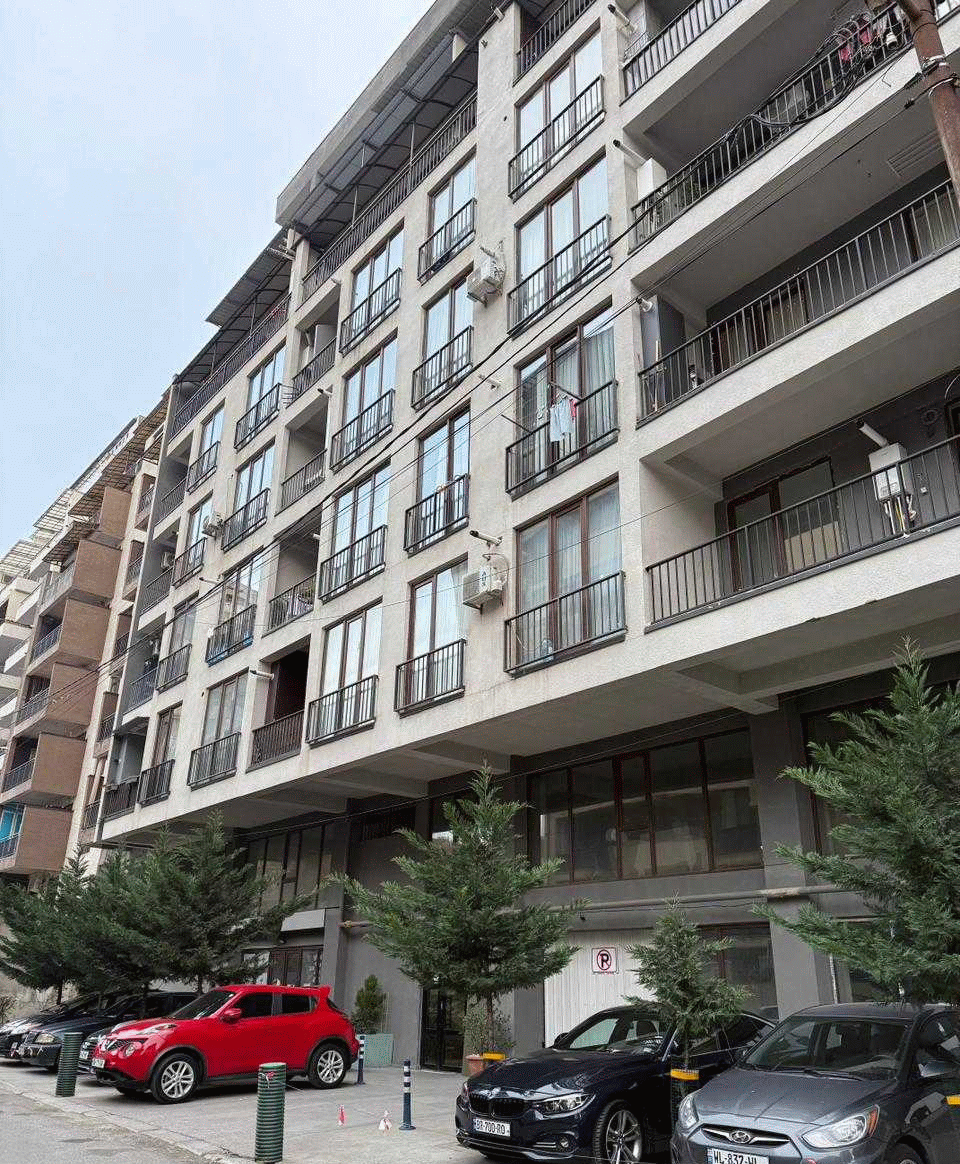
Buying real estate in Tbilisi is often presented online as a simple, low-risk opportunity: affordable prices, friendly tax policies, and fast transactions. While many of these elements are real, they only represent part of the picture. The Georgian real estate market has its own structural characteristics, legal particularities, and construction practices that buyers must understand before committing capital.
This article provides a technical and experience-based overview of what buying property in Tbilisi actually involves, how the market functions in practice, and why independent evaluation is increasingly important. For a broader discussion of market opportunities and construction risks, this article should be read in conjunction with our previous analysis: Tbilisi: Opportunities, Risks, and What Buyers Should Really Look At
.
Why Tbilisi Attracts Foreign Buyers — Beyond the Marketing Narrative
Tbilisi’s appeal is often summarized with generic arguments: affordability compared to Western Europe, a growing tourism sector, and a liberal economic environment. While true, these factors alone do not explain why the city has attracted such a sustained inflow of foreign buyers over the last decade.
A key differentiator is Georgia’s tax and regulatory framework, particularly for individuals with foreign or digital income. Georgia’s “Individual Entrepreneur” regime allows qualifying individuals to pay 1% tax on turnover up to a defined threshold, with minimal reporting complexity. For professionals coming from countries such as Spain, Italy, or France—where combined income tax and social security can exceed 30–40%—this represents a fundamental shift in personal finances.
Additionally, Georgia does not impose capital controls comparable to EU jurisdictions, and property ownership is not subject to recurring wealth taxes or property taxes at Western European levels. For many buyers, real estate in Tbilisi becomes a capital preservation tool as much as an investment.
That said, favorable taxation does not compensate for poor property selection or construction issues. Low friction on the financial side increases the importance of technical due diligence on the asset itself.
Property Ownership and Legal Structure in Georgia
From a legal perspective, Georgia offers a relatively transparent property registration system. Ownership is registered at the Public Registry, and title transfers can be completed in a matter of days—or even 24 hours—depending on the fee paid.
Foreigners enjoy the same ownership rights as Georgian citizens with one major exception: agricultural land. Non-residents cannot directly own agricultural land, a restriction introduced after large-scale speculative accumulation by foreign entities in the early 2010s.
In practice, however, many properties marketed as “homestead” or rural houses sit on land that can be reclassified from agricultural to non-agricultural use. This process is possible but not automatic and depends on zoning, municipal decisions, and existing structures. Buyers considering rural or semi-rural properties should evaluate land status carefully, ideally before negotiating price.
The legal transaction itself is relatively straightforward. Contrary to expectations in Western Europe, notarization is not mandatory for every sale, and many transactions are completed directly at the Public Registry. Payment is typically made via bank transfer (often in USD), though cash transactions still occur depending on amount and counterparties.
Renovated Apartments vs New Construction: Two Different Risk Profiles
Most residential purchases in Tbilisi fall into one of two categories: renovated older apartments or new-build properties delivered in “black frame” or “green frame” condition.
Renovated Apartments
Renovated apartments dominate central districts and historic areas. While some renovations are executed with care and technical understanding, many are designed for rapid resale, not long-term occupancy.
Common issues observed during property viewings include:
-
Structural cracks concealed behind drywall
-
Inadequate reinforcement of old masonry
-
Low-quality electrical panels and cabling
-
Plumbing systems left partially untouched to reduce costs
-
Poor thermal and acoustic insulation
These issues are rarely visible in listing photos and often require on-site observation to identify. A visual condition assessment during the viewing phase can help buyers decide whether a property warrants deeper inspection or should be eliminated early.
New Construction (Black Frame / Green Frame)
New developments are often perceived as “safer,” but this assumption is not always justified. Insulation thickness, window quality, cable type, and installation standards vary significantly between developers.
In black or green frame properties, decisions made at the construction stage—such as electrical layout or plumbing routing—are costly to change later. Buyers unfamiliar with construction standards may overlook deficiencies that affect long-term comfort and operating costs.
Neighborhoods: Central vs Peripheral Reality
Neighborhood choice in Tbilisi has a direct impact on liquidity, rental demand, and long-term value.
-
Old Town offers strong short-term rental demand but comes with heritage restrictions that limit renovation flexibility.
-
Vake remains attractive for long-term residents but commands premium pricing and may not suit every lifestyle.
-
Saburtalo has become a student- and university-driven area, with ongoing development and mixed building quality.
Peripheral neighborhoods may offer lower entry prices, but development timelines are unpredictable. In Georgia, urban expansion often occurs incrementally, and surrounding infrastructure may take years to materialize.
The Reality of Real Estate Agents in Georgia
One of the most misunderstood aspects of buying property in Tbilisi is the role of real estate agents. Unlike regulated markets, anyone can act as an agent, and many listings are simply reposted from online platforms without prior verification or property visits.
It is common for agents to:
-
Have never visited the property
-
Have no technical knowledge of construction
-
Act solely as intermediaries to connect buyer and owner
For this reason, buyers should not rely on agents for technical evaluation. Independent property viewing services can provide a necessary counterbalance by focusing solely on the buyer’s interests and the observable condition of the property.
Financing and Payment Structures
Most foreign buyers in Tbilisi purchase property using self-financing, due to the relative simplicity and absence of leverage requirements. Georgian banks do offer mortgages, but terms for non-residents vary, and down payments are typically substantial.
Developer financing is common for off-plan projects, allowing staged payments during construction. While attractive, these arrangements shift risk toward the buyer if construction quality or timelines are not met. Independent site visits during construction stages can reduce uncertainty.
Why Independent Property Viewing Matters
Given the speed of transactions, variability of construction quality, and limited regulation of intermediaries, independent property viewing and condition assessment play a critical role.
Whether conducted remotely or during an accompanied visit, a structured evaluation helps buyers:
-
Filter unsuitable properties early
-
Identify visible construction risks
-
Decide when certified inspections are justified
-
Allocate time and capital more efficiently
This approach does not replace legal or engineering inspections, but it significantly improves decision-making at the earliest stages.
Conclusion: Opportunity Requires Technical Awareness
Tbilisi remains an attractive market, but it is not a passive investment environment. Favorable taxation and fast transactions can amplify both gains and mistakes. Buyers who rely solely on listings and agents risk acquiring assets with hidden technical or contextual issues.
A disciplined approach—combining legal understanding, market knowledge, and on-site evaluation—allows buyers to distinguish genuine opportunities from cosmetic improvements. In a market evolving as quickly as Tbilisi’s, informed observation remains the most valuable asset a buyer can have.