
Thirteen years ago, it was surprising to find that one of the very few articles available online about the Georgian real estate market painted a clearly negative picture. That article advised against investing in Tbilisi, arguing that the market lacked the potential to evolve in the short or medium term. The reasons presented were disconnected from what could actually be observed on the ground by anyone living in the city at the time.
Today, the situation in Georgia has changed significantly. The same blog that once discouraged investment revised its position several years ago and now highlights the strength of the real estate market and the potential profitability of buying an apartment or a house in Tbilisi or Batumi. This shift reflects broader economic, social, and geopolitical changes that have reshaped the country over the last decade.
Demand Growth and Market Transformation
It is true that since the outbreak of the open war between Russia and Ukraine, and the subsequent migration of citizens from both countries to Georgia, demand for property in Tbilisi and Batumi increased sharply. Initially, this demand was concentrated in the rental market, as new arrivals sought immediate accommodation. Over time, as the conflict continued and temporary stays turned into long-term plans, this demand expanded into the purchase and sale of residential property.
This sustained increase in demand accelerated both construction and renovation activity. New developers entered the market, and existing ones expanded rapidly. Renovation projects multiplied, particularly in older districts of Tbilisi, where apartments with character and central locations could be refurbished and resold quickly.
However, rapid growth also attracts participants whose primary objective is short-term profit rather than long-term quality. In a market like Georgia’s—where European construction regulations are not yet fully implemented or consistently enforced, and where construction standards remain uneven—this creates fertile ground for cost-cutting practices that are not always visible to the untrained eye.
Two Typical Scenarios in the Tbilisi Property Market
Broadly speaking, the residential real estate market in Tbilisi can be divided into two common scenarios: renovated older apartments and newly constructed properties.
Each presents opportunities, but also specific risks.
Renovated Older Apartments: Where Appearances Can Be Deceptive
The first and very common scenario is the renovation of an older apartment. These properties may be inherited, owned by family members, or recently purchased with the sole intention of being renovated and resold quickly.
In a small number of cases, renovations are carried out following European standards and good construction practices. In most cases, however, low-quality materials and shortcuts are used. Since the property is intended for sale rather than long-term occupation, there is little incentive to ensure durability or future performance.
Common Renovation Issues
Masonry and Structural Elements
Low-quality cement is often used for wall repairs. Metal mesh reinforcement—essential to prevent future cracking—is frequently omitted unless damage is already obvious. In more extreme cases, walls are not repaired at all: they are superficially cleaned and covered with drywall sheets to create the illusion of smooth, finished surfaces. In older brick buildings, metal reinforcement of frames and arches is often ignored, even when structural integrity would clearly benefit from it.
Electrical Installations
Cost savings often start at the electrical panel, where low-quality components and simplified installations are common. Insufficient thermal conduits, substandard cabling, and poor-quality corrugated tubing are frequently encountered. Electrical mechanisms such as switches and sockets may be very cheap or imitation products resembling known brands, with questionable safety and longevity.
Plumbing Systems
Bathrooms and kitchens are another area where corners are cut. Savings are made on sanitary ware, taps, and angle valves. Even more concerning is the frequent decision not to replace old piping during a full renovation. Hot water pipes may be left without thermal insulation, increasing energy loss and long-term wear.
Carpentry and Finishes
Carpentry, like paint, has the ability to conceal many defects. Processed woods such as MDF, particle board, and plywood are widely used. While these materials are not inherently bad, it is often difficult for a buyer to distinguish whether they were chosen for technical reasons or purely to reduce costs. Window and door carpentry is especially critical: cheap suppliers—often from abroad—may provide units with poor sealing, thermal bridges, and weak hardware.
Sensitive Areas: Roofs and Basements
Attics and basements are among the most problematic areas. Because access is difficult after renovation, deficiencies often go unnoticed. In attics, it is common to find deteriorated wooden beams, lack of insulation, or improper exterior sealing. In basements and foundations, the replacement or reinforcement of degraded columns is frequently avoided due to complexity and cost. Issues such as humidity, ventilation, and water ingress are often dismissed during renovations focused only on visible living areas.
New Construction: “Black Frame” and “Green Frame” Properties
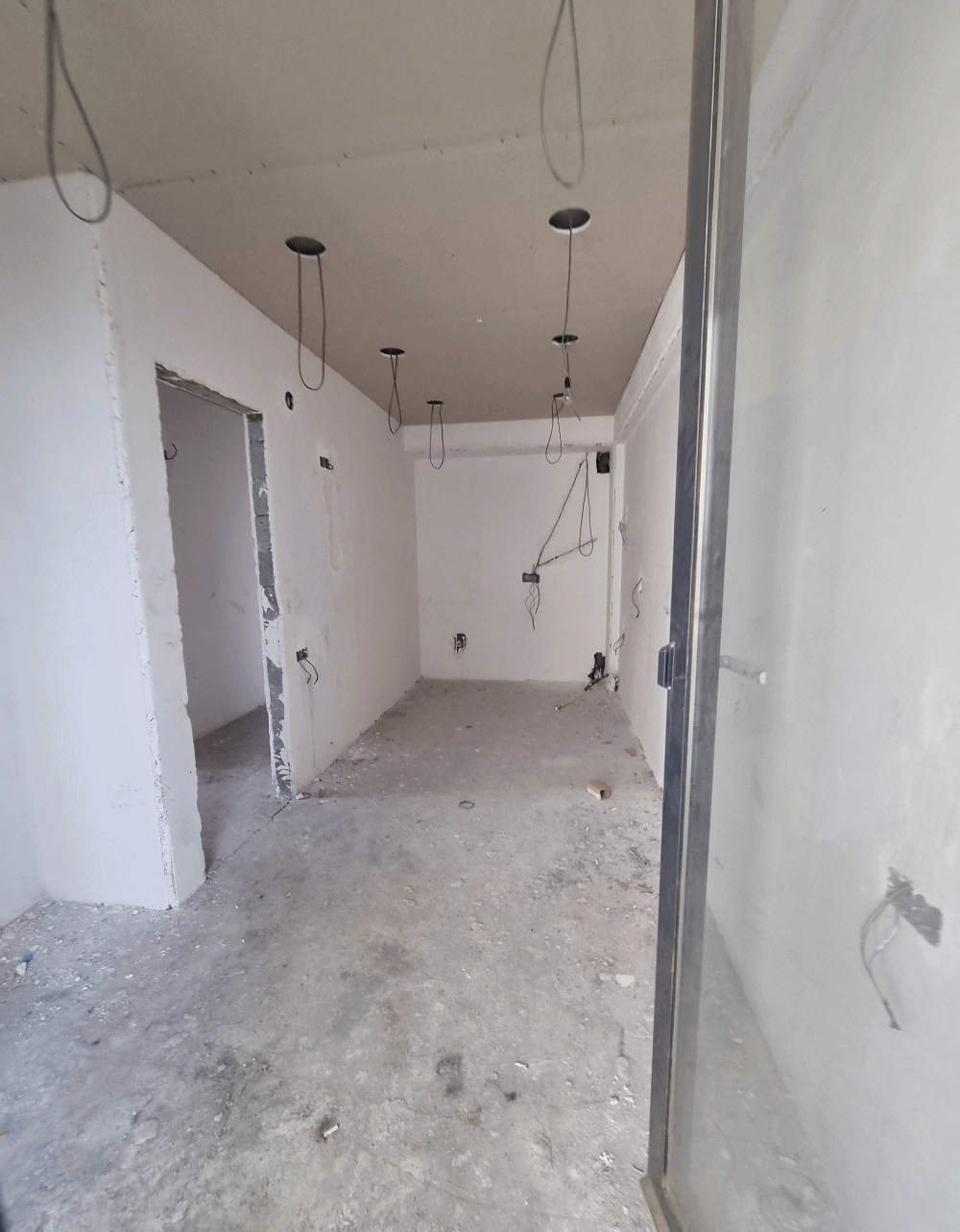
The second scenario involves newly built apartments and houses. In Georgia, these are commonly delivered as “black frame” or “green frame,” terms that describe different stages of completion.
Quality varies significantly depending on the developer, and buyers should not assume that new construction automatically means good construction.
Typical Issues in New Builds
Thermal Insulation and Airtightness
Insulation thickness is often insufficient. In many cases, 30 mm insulation is installed where at least 50 mm would be appropriate. Combined with low-quality windows and non-airtight installations, this results in poor thermal performance, higher heating costs, and reduced comfort.
Electrical Infrastructure
In black or green frame properties, the type of cable used is a key indicator of construction quality. Halogen-free cables, appropriate insulation materials (PVC, polyethylene, rubber), and proper protection all reflect the developer’s intentions. Once grooves are already cut into walls, the placement and quantity of electrical points become critical factors that are costly to correct later.
Plumbing Installations
Because bathrooms are often unfinished at delivery, plumbing shortcuts are harder to detect at this stage. This shifts responsibility to the final owner or renovation contractor, making early assessment even more important.
Windows and Exterior Carpentry
Large windows and exterior doors are potential weak points. Poor installation, inadequate drainage, and thermal bridging can lead to long-term issues even if the window units themselves appear modern or attractive.
Why Independent Property Evaluation Matters
In both renovated and newly constructed properties, many of the most significant risks are not immediately visible to buyers—especially those unfamiliar with local construction practices. This is where independent property viewing and condition assessment services become particularly valuable.
An on-site evaluation focused on observable construction details, materials, and execution can help identify potential red flags early in the process. For buyers who are not in Georgia, remote viewing services provide an initial filter, avoiding unnecessary travel and reducing the risk of investing time and resources in unsuitable properties. For those attending viewings in person, a second opinion during the visit can offer immediate, practical insights that are difficult to obtain from listings or sales agents.
Making Informed Decisions in a Growing Market
Tbilisi remains an attractive real estate market with genuine opportunities. Demand continues to grow, infrastructure improves steadily, and the city’s international profile is stronger than ever. However, growth alone does not guarantee quality, and the pace of development makes careful evaluation more important than ever.
Buying an apartment or house in Tbilisi should not be based solely on price, location, or visual appeal. Construction quality, long-term performance, and hidden costs play a decisive role in whether a purchase becomes a sound investment or a source of future problems.
Conclusion: Opportunity Requires Due Diligence
The Georgian real estate market has matured significantly over the last decade, but it still requires a level of attention and technical awareness that many buyers underestimate. Renovated older apartments and new constructions alike can conceal issues that only become apparent after purchase.
A structured approach—combining market knowledge, on-site observation, and independent assessment—allows buyers to separate genuine opportunities from short-term cosmetic improvements. Whether evaluating properties remotely or attending viewings in person, informed decision-making remains the most effective tool for navigating a rapidly evolving market like Tbilisi.